

Onychocryptosis (aka an Ingrown Toenail)
Onycho = nail
Cryptosis = buried, like a body in a graveyard or mausoleum.
In other words, oncyhocryptosis means the nail is buried deep inside the toe. This sounds painful, and it often is.
What Are Ingrown Toenails?
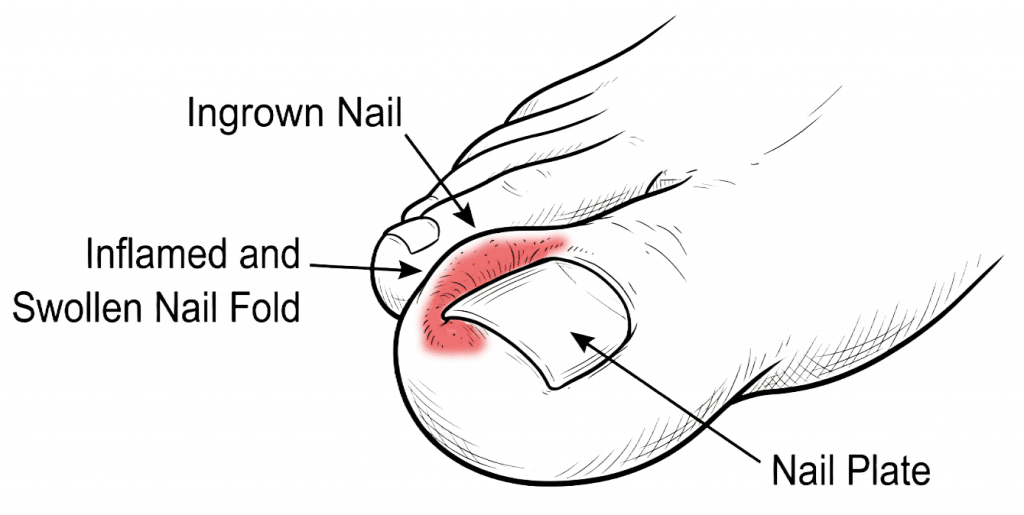
Ingrown nails occur when the corners or sides of the nail borders dig painfully into the soft tissue of the toe. This is a common nail impairment, and can lead soft tissue irritation, redness, and swelling.
Usually, toenails grow straight out. Sometimes, however, one or both corners or sides of the nail curve downward and grow into the flesh. The big toe is the most common location for this condition, but other toes can also be affected.
Ingrown toenails may be caused by the following:
1. Improperly trimmed nails: The most common cause of ingrown toenails is cutting the nails too short. This encourages the skin next to the nail to fold over and impinge on the nail. Leaving behind a rough edge or spike of nail when trimming toenails is another common cause of ingrown toenails.
2. Heredity / genetics: Some people often have a genetic predisposition to curling of the nail, for the sided of the nail to grow into the side of the toe.
3. Shoe / sock pressure: Wearing shoes or socks which are too tight and crowd the toes can place extra pressure on the soft tissue borders of a toenail, crowding the toes. This increased pressure of the soft tissue on the hard unyielding sides of the nail can cause soft tissue irritation and pain.
4. Trauma: Injury to the toes and nails from physical activities can cause nail injury and deformation. Scar tissue can also cause changes in nail shape and growth.
5. Bone spurs: Bone spurs on the top of the toe, beneath the nail, can push up on the middle of the nail from below, causing the nail to curve and dig into the sides of the toe.
6. Callusing: Calluses are one of the body’s defense mechanisms against mechanical injury to the skin. Chronic ingrowing and pressure from the nail borders on the adjacent soft tissue can cause callus tissue to build up on the skin next to the edge of the nail. This thickening of the skin can put increase pressure on the nail and soft tissue, resulting in increased pain.
7. Swelling of the feet: Swelling in the toes can cause increased pressure from the soft tissue on hard unyielding nail borders and corners. This can result in soft tissue irritation and pain.
8. Nail fungus: Fungus frequently results in changes to nail thickness, shape, and growth. This can result in ingrowing and pain.
The following symptoms may be present with ingrown toenails:
• Pain, particularly with pressure to the nail border
• Redness
• Swelling
• Increased skin temperature
• Drainage (bloody, clear serous, pus)
• Malodor
• Prominent skin tissue (proud flesh)
• Skin growing over the nail
• Callusing to the nail border
Home Treatment
• Immerse the foot in a basin of warm Epsom saltwater soak (unscented is generally better), or soapy water (antibacterial is best).
• Apply over the counter topical antibiotic ointment to the area.
• Wear shoes with a wide toe box or open toe, to minimize pressure from the shoe on the nail border.
• Carefully trim the nail. Trimming the ingrown part of the nail can help relieve pressure. This should be done with caution, however. Do no cut the nail too short or round the edges. Doing so may encourage further growth into the skin.
• Over the counter pain medication can help with pain in the short term. These should not be a long-term treatment strategy.
People with diabetes, peripheral neuropathy, peripheral vascular disease, other circulatory disorders, or immune system disorders / suppression must avoid any form of self-treatment and seek podiatric medical care as soon as possible. These co-morbidities can dramatically increase the risk associated with ingrown toenails.
Treatments aimed at softening a nail can sometimes be helpful in milder cases. These would include options such as OTC topical urea gel 45-50%. If successful, this usually takes several weeks to see improvement. Sodium sulfide gel, commonly found in OTC ingrown nail treatments should not be applied if there is an open wound, break in the skin, or infection.
Attempting to dig the nail out yourself frequently makes the problem worse and should be avoided, particularly if one has diabetes, peripheral neuropathy, peripheral vascular disease, other circulatory disorders, or immune system disorders / suppression.
Many home readies are ineffective at best and cause increased pain and symptoms at worst:
• Do not notch the toenail. Toenails are hard rigid objects, a small notch in the toenail is not going to decrease pressure on the nail borders or cause the nail to flatten out and dig into the toe less.
• Do not place cotton or dental floss under the nail border. Lifting the side of the nail up enough to place cotton or dental floss under the nail border is generally quite painful. Once the cotton or dental floss is in place, this puts extra pressure on the nail border, which also causes increased pain. Lifting up the nail can enable bacteria or fungus growth under the nail border.
• Do not use toenail straighteners or braces. These are ineffective at best, and in the case of mechanical screw driven clamps cause increased pain.
Attempting to dig the nail out yourself frequently makes the problem worse.
Do not take care of your nails yourself if you are not able to adequately see or reach the toes and toenails, have peripheral neuropathy, or have poor circulation to the toes. If you are not able to take care of the nail safely yourself, family members or trained pedicurists can often be helpful.
Prevention is the best treatment.
• Trim the toenails properly. Cut them straight across, in a fairly straight line, flush with the skin. Do not dig into the corners and only gently round off corners with a nail file.
• Use a toenail clipper with a straight edge to ensure your toenail is cut straight across. Other tools like manicure scissors or fingernail clippers increase the risk of ingrown toenails because of their small, curved shape.
• Avoid shoes with pointy or narrow toe boxes. Give those toes room.
• Conversely, avoid shoes which are too loose. Feet sliding around in a shoe can also cause increased pressure from the shoe on the toes and nails.
• Avoid socks which are tight around the toes. Give those toes room.
• Never rip or tear the edges of nails.
• Do not dig into the cuticle.
• Soaking the feet and gently exfoliating the skin can help prevent buildup of hard callused skin on the nail borders.
Do not take care of your nails yourself if you are not able to adequately see or reach the toes and toenails, have peripheral neuropathy, or have poor circulation to the toes. If you are not able to take care of the nail safely yourself, family members or trained pedicurists can often be helpful.
When to Visit a Podiatrist
• If you suspect an infection or open wound due to an ingrown toenail, you should have the toe evaluated by a foot and ankle specialist. Oral antibiotics and/or a procedure may be necessary.
• If your symptoms do not go away or are getting worse.
• If a short attempt at home / self-treatment is not working.
• If this is a chronic recurring problem.
• If this is affecting your quality of life, limiting physical activity, or causing significant pain.
• If you have diabetes, peripheral neuropathy, peripheral vascular disease, other circulatory disorders, or immune system disorders / suppression you should see a podiatrist right away. Ingrown toenails can lead to more severe complications. Nail problems should be evaluated and treated by your podiatrist, who can diagnose the ailment, and then prescribe medication or another appropriate treatment.
Professional Treatment
A podiatrist will examine the toe and remove the ingrown portion of the nail and may prescribe a topical or oral antibiotic to treat any infection. Removing the ingrowing portion of the nail is often necessary to treat the source of the infection, the ingrowing, and the pain. The nail border can be removed temporarily or permanently. With the “permanent” removal a chemical is applied to the matrix, or root of the ingrowing portion of the nail in an effort to prevent the nail from growing back on that side. This can also be done with surgical sharp excision of the nail border.
Most people experience very little pain after the procedure, as long as they are not kicking the toe, dropping something on it, or wearing shoes which are too tight. Pain medication is generally not necessary. Most people resume normal activity and exercise the next day. Swimming is not recommended until the toe is healed. Give us a call at (907) 931–1726 or book an appointment now with the online scheduler to schedule a consultation. Same or next day appointments are often available. Let us help you get back to physical activity and living pain-free with expert care for your ingrown toenails.