

Custom Orthotics
Orthotics are like eyeglasses – but made for the feet rather than the eyes:
• They are both corrective devices which only work when worn
• They can improve function and reduce strain
• They do not change anatomic structure, but:
• Orthotics do support muscles, ligaments, tendons, and relieve stress on joints.
• Orthotics do change contact pressure points and weight distribution.
• A custom prescription provides the best result, and periodic prescription updates are recommended.
Are your feet painful?
Are your feet limiting your physical activity?
Orthotics may be the answer.
Call us at (907) 931–1726 and ask about pricing.
Book an appointment now with the online scheduler for an evaluation to discuss if orthotic therapy would be beneficial for you.
3D Printed Custom Orthotics
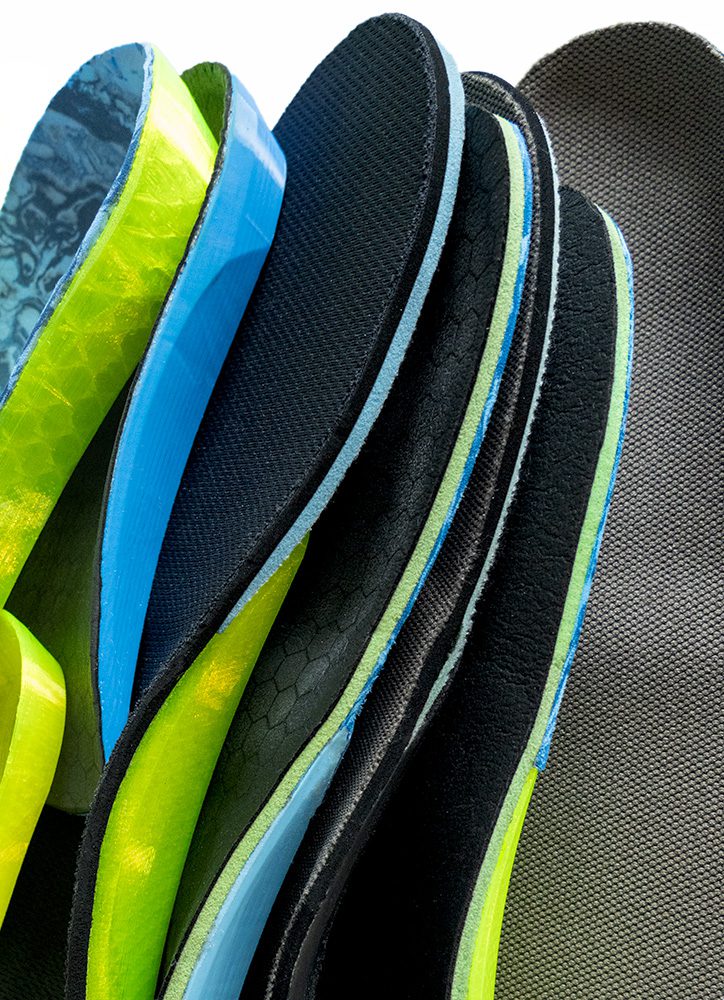
We specialize in custom orthotic therapy and are the only clinic in the state offering onsite 3D custom orthotic printing. 3D printing technology unlocks new abilities not present with older technologies in orthotic prescriptions. With 3D printing orthotic increased support can be mapped to regions of an insert where it is wanted and decreased from regions where it is not. A 3D printed orthotic can provide support or changes in contact pressure points while maintaining flexibility and avoiding unnecessary restriction of mid and hindfoot motion. 3D printed orthotics are not suitable for all individuals. The level of support, control, and pressure redistribution needed varies from individual to individual, and from one problem being treated to another.
Over the counter arch supports vs prefabricated arch supports vs custom foot orthotics
Which do I need? This is a question best answered by your foot and ankle provider after an examination and review of your problem.
Prescription medications are prescribed at the lowest dose possible to achieve the intended benefit. Orthotics are similar in this respect. Starting with an over-the-counter device is a great place to begin. If that is not working and is not providing the desired pain relief, then a step up to a prefabricated insert or a custom orthotic would be the next step up in increasing the “dose” or power of the treatment.
Custom orthotics historically have used plaster molds or foam box impressions of the feet to create a model on which the orthotic is made to custom match your foot size and shape. This process is now generally done digitally, creating a 3-dimensional model of your feet using lidar imaging and scanning software. From this digital model of the foot the insert is either 3-D printed on site, or 3-D milled offsite. The fabrication process used is, once again, chosen based on the problem being treated and the intended use. 3-D milled orthotics are more rigid and helpful for applications and deformities where greater control is necessary. 3-D printed orthotics provide needed support, but still maintain flexibility for situations where locking up joints and the intrinsic muscles of the feet is not necessary.
Chugach Sports Foot and Ankle Specialists is the only foot and ankle provider in Alaska 3-D printing orthotics on site.
Custom orthotics are made from a variety of materials which are chosen based on the problem being treated and their intended use. An orthotic top cover often uses various foams and rubbers, such as polyurethane, EVA, and neoprene. Vinyl, cork, and microfiber are also often used. The orthotic shell itself is made of more substantial materials such as polypropylene, thermoplastic polyurethane, PEBA, and graphite.
Custom orthotics can be acquired through a couple of different avenues. Podiatrists, physical therapists, chiropractors, and pedorthists / prosthetists, depending on their training, can all make custom orthotics.
Non-medical inserts can be customized as well for a specific purpose from the local ski / snow board shop, the skate shop, or local running store. As these are not medical grade inserts, one should have a specific goal in mind of what is desired with these insoles and then communicate that to the technician. These should be cheaper than a medical grade custom orthotic but are more expensive than an off the shelf insole.
Whoever makes the insert though should be passionate about the whole orthotic process. Custom orthotics are an art. They can be fiddly and take some tweaking to optimize. The princess and the pea had nothing on the sensitivity some people have to any changes in the surface they walk on. Whomever make the orthotics should be fully engaged in the process from start to finish, from the capture of the foot shape to the customized prescription to the fabrication process.
Here at Chugach Sports Foot and Ankle custom orthotics are one of our areas of special interest and focus. We do enjoy working with patients to maximize their foot health and comfort with orthotics. Not everyone needs orthotics, let alone custom orthotics. Some problems need more than an orthotic can deliver and require AFOs or surgery. Ankle foot orthoses are an orthotic which wraps around covers the heel to a greater extent and has a brace portion extending above the ankle. Some conditions respond well to changes in shoes alone, or foot rehabilitation exercises. If you have any questions about what is right for your feet, or you have had a bad experience with orthotics produced elsewhere, come on in for an evaluation! Bring with you the devices which you have already tried. This helps us avoid reinventing the wheel and redoing what has not worked for you.
Custom orthotics are generally made to fit the foot being treated and its particular challenges, not the shoe they are placed in. Depending on how tight your shoes are, a larger shoe size may be necessary to accommodate both your foot and orthotic at the same time inside the shoe. For specialized applications in low volume shoes where a tight fit is preferred, such as sport cleats, skates, and ski boots, a custom orthotic can be custom made to fit both the boot / cleat and the foot. This process requires leaving the boot / cleat on site during the fabrication process. This type of orthotic can help with athletic performance but is generally not suited for everyday wear.
For our runners we are excited to offer custom 3-D printed orthotics fabricated from PEBA (polyether block amide) or TPU (thermoplastic polyurethane), the same super foams used in many higher end running shoes. These are the same foams used by the current generation of elite distance runners in their overwhelming assault on timed records.
PEBA orthotics are lighter than those printed from other materials and have greater energy return.
PEBA has many advantages with cold weather performance, a major part of the year here in Alaska. Studies comparing PEBA to EVA (ethylene-vinyl acetate) foam in shoe midsoles have shown PEBA has greater energy return and cold performance than EVA. PEBA, unlike EVA, does not show significant change in flexibility or impact resistance at cooler temperatures. EVA foam hardens significantly in cold weather, losing its cushioning, flexibility, and energy return.
Greater energy return can equal faster speed. PEBA also helps with faster recovery after a hard run. Everyone appreciates performance boosts, not just elite professional athletes.
Research by Victor Rodrigo-Carranza in 2023 showed peak race performance in a PEBA shoe midsole to be less than 450 km (280 miles). After 280 miles PEBA midsoles are good for daily training purposes and no worse than EVA. On the other hand, Geoffrey Burns in 2024 demonstrated PEBA foams maintain their high performance characteristics even after extensive use. Super foams are an intense area of current closely guarded research by shoe companies. While the jury is still out on the durability of PEBA midsoles, there is no controversy on their performance enhancing characteristics.
You can now get the advantages of PEBA in your custom orthotic!
Chugach Sports Foot and Ankle Specialists is the only provider in Alaska with the capability to manufacture PEBA custom orthotics!
Sometimes.
Some insurance carriers will pay for custom orthotics and / or prefabricated orthotics. There is so much variability between carriers, and even within different plans offered by the same carrier, that it is best to call your carrier and check first.
• Custom orthotics are CPT code L3020 and one pair equals two units.
• Prefabricated orthotics are CPT code L3040 and one pair equals two units.
Key Questions to Ask Your Carrier:
1. Are orthotics a covered benefit for your plan?
2. If yes, under what circumstances?
3. If yes, how many units, and how often?
4. If yes, does billing for L3040 (prefabricated orthotics) negate subsequent coverage for L3020 (custom orthotics)?
During the next few weeks your body will gradually become accustomed to the new alignment your orthotics are promoting. Each human body is different, so the exact period of adjustment is difficult to determine. It generally takes 1-2 weeks, but can take up to 4-6 weeks, particularly if they are not being used regularly. Start with an hour or two, and gradually build up from there. During this adjustment and break-in period you may experience mild discomfort in other parts of the body, such as the knees, hips, or back. This discomfort is transient and should disappear as the orthotics enable the feet to realign, achieve the correct posture, and function more efficiently. Avoid using the orthotics for high impact physical activity, such as running or jumping during the initial phases of the break in process, as this may accentuate any discomfort felt during this phase.
After this initial break in process your custom orthotics should be comfortable. If they are not comfortable it is unlikely they will be used. If your custom orthotics are not comfortable you should follow up with your foot and ankle provider as adjustments may be necessary.
Once the orthotics break in process is done, after 4-5 weeks of full time use you should be able to tell if the orthotics are helping with the problem they were prescribed for. If they are not helping, you should follow up with your foot and ankle provider to discuss whether adjustments or other treatment options may be necessary. If you are orthotics are working as anticipated then go forth and be active!
Instructions
1. If your orthotics come with a full-length top cover, remove the factory insole, if possible, prior to placing the insert into your shoes. This can help prevent the shoe from being too tight around the toes. You may need to trim the top cover on your new custom orthotics in order to accommodate the length and width of your shoes without bunching or folding of the material.
2. If your orthotics do not come with a full-length top cover you may place them beneath the factory insole to help prevent the inserts from sliding around when donning your shoes. Alternatively, you may place the custom orthotics on top of the factory insole to make switching them from shoe to shoe easier.
3. Wear your orthotics for one-two (1-2) hours the first couple of days, three-four (3-4) hours the next few days, etc. You may wear them more if comfortable, or less, if necessary.
4. It is common to have some discomfort in your feet and calves up through the first couple of weeks. At the end of three (3) weeks, if you are still having discomfort, you need to call the office and make an appointment to see your doctor for potential adjustment – make sure to indicate the appointment is in regard to your orthotics.
5. Wear stockings or socks with your orthotics to minimize the possibility of skin irritation.
6. Shoe construction will affect the fit and function of your orthotics. Custom orthotics function most effectively in closed shoes rather than open backed or slip on shoes. When purchasing new shoes bring your orthotics with you to ensure proper fit.
7. Occasionally the orthotics may squeak in your shoes. This can be eliminated by lightly dusting baby powder into the shoes, or rubbing candle wax or paraffin on the bottom of the orthotic shell.
8. Care and cleaning: wipe with soap and lukewarm water (never hot); do not use oil or Vaseline on leather-covered orthotics. Avoid soaking. Allow 24 hours before re-using, if wet.
9. Should the material on the bottom of your orthotics appear to be worn, or should the devices break, return them to our office. Do not attempt to correct or modify them yourself.
10. If you have any questions about your treatment, please feel free to discuss them with us. Your problem cannot be corrected if the doctor remains unaware of it. Most difficulties can be corrected quickly and easily.
Custom-made orthotics are designed for durability and typically last longer than over-the-counter inserts. You should replace your orthotics every 1 to 5 years, but the exact timing depends on factors like your activity level, the type and materials of the orthotics, and your lifestyle. High-demand users may need them replaced more frequently (closer to one year), while others with moderate use may get two or three years from a pair.
The top cover often wears out before the orthotic shell and may be refurbished for cheaper than the cost of a new pair of orthotics.
Signs it is time for a replacement:
• Listen to your body for signs of pain. If the orthotics are no longer as helpful in alleviating pain, or are no longer as comfortable as they once were, this is an indication a new prescription is generally in order.
• If the structure of your foot has changed, such as from surgery, injury, pregnancy, or deformity progression, then a new prescription is recommended.
• If the orthotic shell is showing visible signs of mechanical wear and damage, such as thinning, cracks, or pieces broken off, then a new prescription is recommended.
• Pediatric orthotics should generally be replaced every year, or whenever the child’s foot has increased by two full sizes. Outgrowing an insert can be due to growth spurts and high activity levels. An annual exam until the child reaches skeletal maturity and stops growing is recommended. During this annual exam a podiatrist is able to assess the fit of the devices and determine if modifications or replacements are necessary.
• If there are any doubts about whether your orthotics need adjustment, repair, or replacement bring them into the office with your feet for evaluation.
Call NOW for an Appointment: